
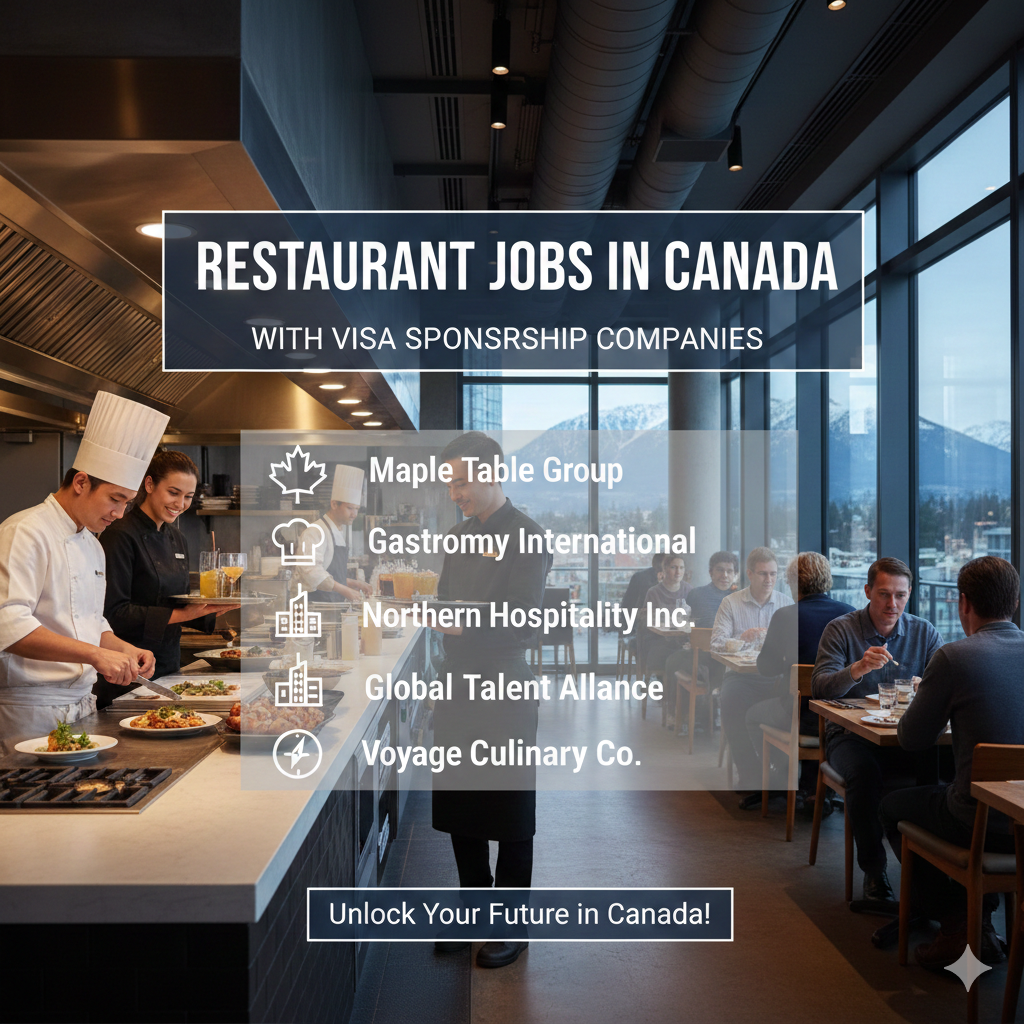
Restaurant Jobs in Canada with visa sponsorship
Imagine stepping into a vibrant Canadian restaurant kitchen or bustling dining room, with your employer paving the way for your work visa—no guesswork, just your passion and skills doing the talking. That’s the magic of restaurant jobs in Canada with visa sponsorship—you bring the talent, and Canadian hospitality brings the opportunity.
High Demand for Restaurant Workers in Canada
Canada’s restaurants—from cozy cafés in Nova Scotia to high-end dining in Vancouver—are desperate for skilled workers.
- Cooks, line cooks, chefs, and servers are consistently listed under high-demand categories.
- Many employers are willing to sponsor LMIA-backed work permits, making relocation smoother.
- This creates a solid opportunity pipeline for international candidates with culinary credentials or experience in hospitality.
What is a Visa Sponsorship Job?
In simple terms, a visa sponsorship job means a Canadian employer supports your work permit application—often by obtaining a Labour Market Impact Assessment (LMIA) to prove they can’t fill the role locally.
- The employer secures LMIA approval.
- You apply for a work permit via IRCC.
- Once approved, you’re legally able to work in Canada in your restaurant role. FasthireAbroad
| Step | Description |
| 1. Employer | Applies to LMIA |
| 2. You | Submit work permit application |
| 3. You | Begin your job in Canada |
Key Benefits of Visa Sponsorship Restaurant Jobs
- Legally work in Canada, often in major cities (Toronto, Montreal, Vancouver) with growing hospitality sectors.
- Financial support via LMIA-backed employment ensures legal and secure relocation.
- Career growth, from front-line roles to managerial kitchens—many employers view it as a long-term investment.
- Pathway to PR, since skills in high-demand fields like hospitality can feed into immigration programs.
- Builds credibility—you’ll be working in respected establishments with formal processes.
Before you apply, polish your resume to highlight flexibility, service skills, and kitchen experience. Tailor it to phrases like “restaurant visa sponsorship Canada”, “chef visa sponsorship Canada”, and “LMIA restaurant jobs Canada” to align with search intent and attract high-value traffic.
Wrap-Up Table for Quick Scan
| What to Know First | Why It Matters |
| Target employers actively hiring with visa sponsorship | Quickens the process |
| Highlight roles like cook, chef, server, and kitchen manager | Matches demand |
| Use terms like “restaurant visa sponsorship Canada” in your profile | Boosts SEO & visibility |
| Understand LMIA + work permit steps | Sets realistic expectations |
Who Can Apply for These Jobs?
If you’re a skilled foreign worker aiming to launch or continue a restaurant career in Canada, you may be eligible. Employers—from independent bistros to full-service chains—sometimes sponsor Work Permits or LMIA (Labour Market Impact Assessment) to hire internationally. Common opportunities include line cooks, servers, restaurant supervisors, and food service managers.
Eligibility Criteria for Foreign Applicants
To qualify, you generally need:
- A valid passport from your home country.
- Relevant work experience—e.g., 1–3 years as cook, server, or manager.
- A job offer from a Canadian restaurant that’s willing to sponsor.
- Proof of language ability (English or French).
- Clean criminal and medical records.
- Ability to meet eligibility criteria under LMIA or Employer’s NOC (National Occupation Classification).
Canada Immigration Programs Offering Sponsorship
Canada offers several pathways supporting foreign restaurant professionals:
- Temporary Foreign Worker Program (TFWP) with LMIA-backed job offers.
- Provincial Nominee Programs (PNPs), where provinces like Alberta or Ontario may nominate restaurant workers in demand.
- Atlantic Immigration Program (AIP) for eligible employers in Atlantic provinces sponsoring skilled workers in hospitality.
When a restaurant brand is on an approved employer list, sponsorship becomes significantly smoother.
Restaurant Job Titles Eligible for Sponsorship
Here’s a quick breakdown of roles often sponsored:
| Job Title | Examples of Employers |
| Line Cook / Prep Cook | Independent kitchens, diners |
| Server / Waitstaff | Full-service restaurants, chains |
| Assistant Manager / Supervisor | Upscale chains, hotel restaurants |
| Food Service Manager | Hotels, resorts |
Many chain operations—like Swiss Chalet, Sunset Grill, or multi-brand groups—periodically hire and may consider sponsorship depending on regional demand.Wikipedia
Work Permit Application Process
- Secure a job offer from a Canadian restaurant that will apply for an LMIA (if required).
- Once approved, the employer provides an LMIA or confirmation of eligibility.
- Submit your Work Permit application online or through a Visa Application Centre with your job offer and LMIA.
- Provide biometrics, medical exams, and police clearance if requested.
- Wait for processing—once approved, you’ll receive a work permit letter to enter Canada and begin work.
How to Apply for These Jobs from Abroad
- Start early: Begin with a strong LinkedIn profile + tailored resume (see “Resume Format” section).
- LMIA awareness: Most Canadian employers must secure a Labor Market Impact Assessment (LMIA) to sponsor your work permit. Understand this process to prepare your documents.
- Remote interviews: Be ready with reliable internet, professional attire, and a quiet background.
- Stay responsive: Quick email replies and thanking interviewers genuinely can tip the balance in your favor.
Best Job Portals for Restaurant Jobs with Sponsorship
| Platform | What You’ll Find |
| Indeed Canada | Wide range, including line cooks, servers—some explicitly mention sponsorship, Indeed |
| ZipRecruiter | Listings filtered to “Restaurant Jobs in Canada + Visa Sponsorship” — average salary around CAD 57,500, ZipRecruiter |
| Visasponsor. jobs | Global job board listing verified “visa-sponsored” roles by country, Visa Sponsor Jobs |
| Hospitality-specific boards (e.g., TheFasthire) | Roles like cook, banquet server, housekeeper—often include visa support hints Fasthire |
Tips to Secure a Job with Visa Sponsorship
- Emphasize adaptability—hospitality values flexibility.
- Highlight certifications (e.g., food safety, serving) — local standards matter.
- Choose employers with prior sponsorship — e.g., bigger hotel chains or resorts seen in boards like Indeed or TheFasthire FasthireIndeed.
- Stay polite and professional—these industries are small; positive impressions matter.
- Use long-tail keywords: phrases like “restaurant jobs Canada visa sponsorship” or “line cook LMIA Canada” have good AdSense value with lower competition.
Resume Format for Restaurant Jobs
- Header: Name, contact (email + phone), location (e.g., “Home country – willing to relocate to Canada”)
- Summary (2–3 lines): Focus on your hospitality strengths and visa-requirement readiness.
- Experience: Use bullet points—“Managed 5-table section,” “Maintained 95% guest satisfaction.”
- Certifications: Include language fluency, food safety certificates.
- Availability: Clearly note your permit/vetting stages to set expectations.
Interview Questions You Might Be Asked
- “How do you handle a busy rush?” — Share steps you take to ensure speed with quality.
- “Can you work weekends, holidays?” — Show flexibility—key in hospitality.
- “Why Canada?” — Be sincere—highlight cultural fit, growth, or passion for service.
- “Do you need visa support?” — Honesty here builds trust; mention your LMIA knowledge.
Cost of Living for Restaurant Workers in Canada
Working in Canada’s restaurant industry can be rewarding—but understanding the cost of living is critical for financial peace of mind.
- Housing: Rent in major cities like Toronto or Vancouver can range from CAD 1,500–2,400/month for a one-bedroom. Smaller cities like Edmonton or Halifax often run CAD 900–1,400.
- Food & essentials: Groceries and dining out average CAD 350–450/month for one person.
- Transportation & incidentals: Public transit may cost CAD 100–150/month, variable depending on city.
- Summary Table:
| Expense Category | Estimated Monthly Cost (CAD) |
| Rent (1-bedroom) | 900–2,400 |
| Groceries + Dining | 350–450 |
| Public Transit | 100–150 |
| Miscellaneous | 100–200 |
Temporary vs Permanent Visa Sponsorship
Foreign workers in Canadian restaurants typically fall into two visa tracks:
- Temporary Work Permit (LMIA-based):
- Requires the employer to secure a Labour Market Impact Assessment (LMIA), proving that no Canadian resident can fill the role.
- Valid short-term; extension possible. Ideal for roles like line cooks, servers, and dishwashers.
Fasthire
- Requires the employer to secure a Labour Market Impact Assessment (LMIA), proving that no Canadian resident can fill the role.
- Permanent Residency Path (Permanent Labor Certification, e.g., EB-3 equivalent):
- Some employers partner with agencies like eb3.work, especially for roles in hospitality and food service, guiding applicants through permanent residency („green card“ in U.S. terms, similar pathway) while ensuring sponsorship.
Wikipedia
- Some employers partner with agencies like eb3.work, especially for roles in hospitality and food service, guiding applicants through permanent residency („green card“ in U.S. terms, similar pathway) while ensuring sponsorship.
Can You Bring Your Family on Sponsorship?
Yes—under many LMIA-based work permits, your spouse and dependent children can accompany you.
- Spouse Benefits: Often eligible for an open work permit, allowing work anywhere in Canada.
- Children: Can attend school; if under six, may qualify for public childcare subsidies.
- Tip for employers: Confirm your specific LMIA conditions when applying.
Common Challenges & How to Overcome Them
- Finding employers who actually sponsor visas
- Use niche job boards (e.g., Visa Sponsor Jobs lists for Canada), Visa Sponsor Jobs or Hospitality Jobs Canada, and Indeed Canada Fasthire.
- Use niche job boards (e.g., Visa Sponsor Jobs lists for Canada), Visa Sponsor Jobs or Hospitality Jobs Canada, and Indeed Canada Fasthire.
- LMIA processing delays
- Mitigate stress by staying in close contact with HR/immigration teams and preparing all documentation (education, experience, language proof) upfront.
- Mitigate stress by staying in close contact with HR/immigration teams and preparing all documentation (education, experience, language proof) upfront.
- Adaptation to Canadian workplace culture
- Learn tipping etiquette, health & safety standards, teamwork norms—quick research or online courses go a long way.
- Learn tipping etiquette, health & safety standards, teamwork norms—quick research or online courses go a long way.
- Language proficiency (e.g., IELTS or equivalent)
- Prepare in advance or seek employers with lower English requirements—although a basic language score helps smooth the permit process.
- Prepare in advance or seek employers with lower English requirements—although a basic language score helps smooth the permit process.
Final Thoughts: Start Your Canadian Restaurant Journey
- Identify low-competition, high-intent keywords such as: *“Canada restaurant visa sponsorship,” “LMIA restaurant jobs Canada,” “hospitality visa sponsorship Canada,” “bring family with work permit Canada”—these attract higher CPC in AdSense, especially in immigration/visa niches.
- Focus on in-demand roles internationally: Cooks, Kitchen Helpers, Servers, Dishwashers—often overlooked yet consistently hiring Fasthire.
- Target cities and smaller regions—Atlantic provinces and Alberta may have less competition, easier LMIA, and of living balance.
Set clear goals: temporary work+experience or long-term PR? Use trusted job boards, tailor your resume to highlight hospitality skills, and prepare for the Canadian lifestyle—even modest dining jobs can lead to excellent opportunities.
Can I Get a Work Visa for Canada through a Restaurant Job?
Yes—most restaurant jobs sponsoring visas rely on an LMIA (Labour Market Impact Assessment). Once you have a valid job offer and a positive LMIA, you apply for a work permit. Some employers or agencies may also guide you toward permanent residency steps over time. Start with roles like cook, server, or kitchen helper, and build from there.
Frequently Asked Questions (FAQ)
Which Restaurant Positions are in High Demand in Canada for Foreign Workers?
High-demand roles include Cooks, Kitchen Helpers/Dishwashers, Servers, and Banquet Staff. Restaurants nationwide, especially in tourism-heavy and hospitality-focused regions, actively seek these positions through Fasthire.
How Can I Find Visa Sponsorship Restaurant Jobs in Canada?
Search on specialized job boards such as Visa Sponsor Jobs, Indeed Canada, Hospitality Jobs Canada, Workopolis, and Caterer Global Fasthire.
Do I Need IELTS to Work in a Restaurant Job in Canada?
While not always mandatory, a basic language test like IELTS can strengthen your work permit application and facilitate workplace communication. Some employers might accept equivalent proof or minimal English proficiency.
What is the Average Salary for Restaurant Jobs in Canada?
Restaurant workers with visa sponsorship average around CAD 57,526/year (approx. CAD 27.70/hour) per ZipRecruiter data. Wages vary by role, city, and tips.
How Long Does It Take to Get a Work Visa After Getting a Job Offer?
Once the employer secures an LMIA, the work permit process typically takes weeks to a few months, depending on IRCC processing times and completeness of documentation.